Self-Supervised Implicit Attention Priors for Point Cloud Reconstruction


Abstract
We address the ill-posed problem of recovering high-quality surfaces from irregular point clouds by introducing an implicit self-prior that distills a shape-specific prior directly from the input. Our approach jointly trains a small dictionary of learnable embeddings with an implicit distance field; at every query location, the field attends to the dictionary via cross-attention, capturing and reusing repeating structures and long-range correlations inherent to the shape. Optimized solely with self-supervised point cloud reconstruction losses, requiring no external training data, the trained field is sampled to extract dense points and analytic normals, which are fed into a Robust Implicit Moving Least Squares (RIMLS) formulation to produce the final surface. Our method outperforms both classical and learning-based approaches in generating high-fidelity surfaces with superior detail preservation and robustness to data degradations.
Method
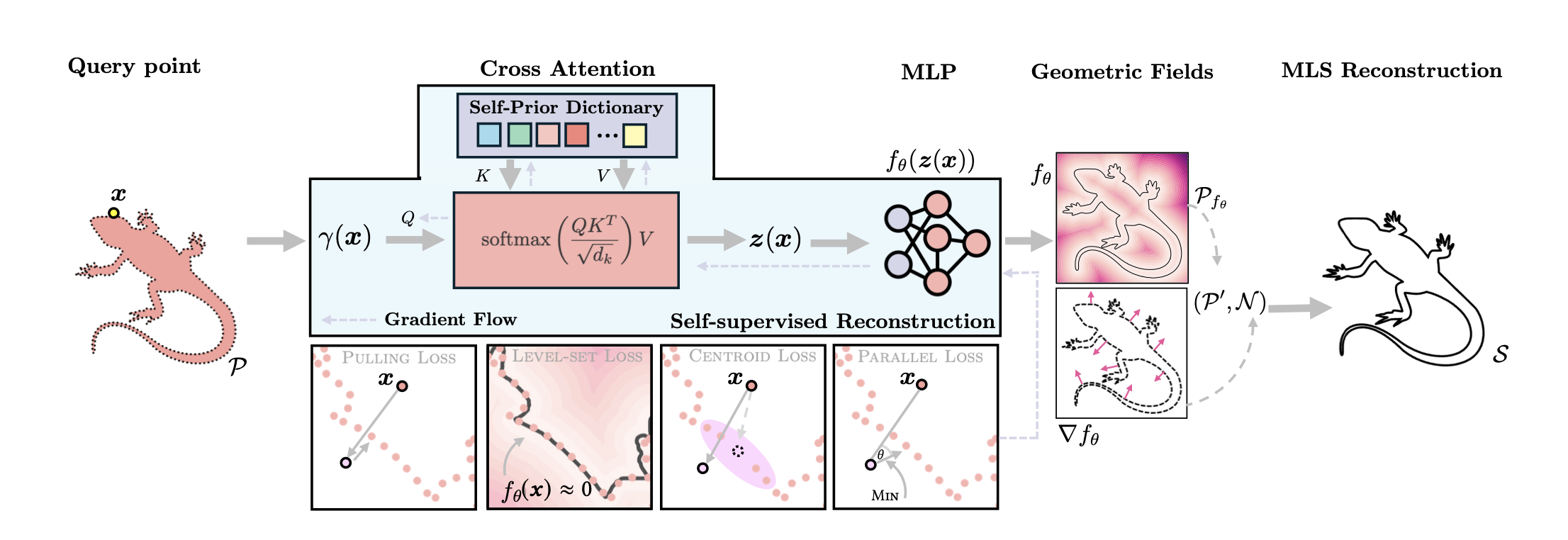
Stage 1: Implicit Attention Prior
A shared dictionary of learnable embeddings acts as a self-prior: every spatial query attends to it, coupling structurally similar but spatially distant regions of the shape. The field is trained purely from the input point cloud using four losses:
Total loss: $\mathcal{L} = \alpha\mathcal{L}_\alpha + \beta\mathcal{L}_\beta + \gamma\mathcal{L}_\gamma + \delta\mathcal{L}_\delta$ Hover over a term to highlight it in the diagram.
Stage 2: RIMLS Surface Refinement
The trained field inpaints sparse regions and provides analytic normals via autodiff. These are passed to Robust Implicit Moving Least Squares (RIMLS) to produce the final surface mesh.
Results
Self-similar shape reconstruction
Drag to compare our method against baselines on shapes with strong repeating structure. The implicit attention prior consistently recovers fine geometric detail that data-driven and purely local methods miss.
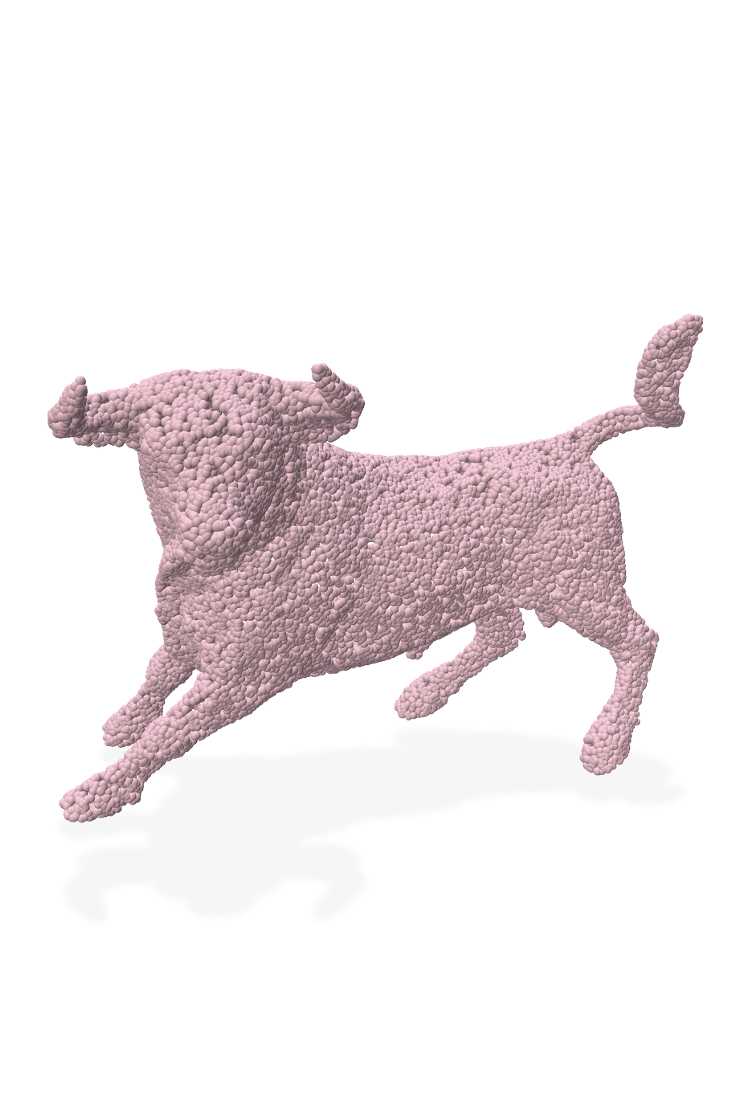
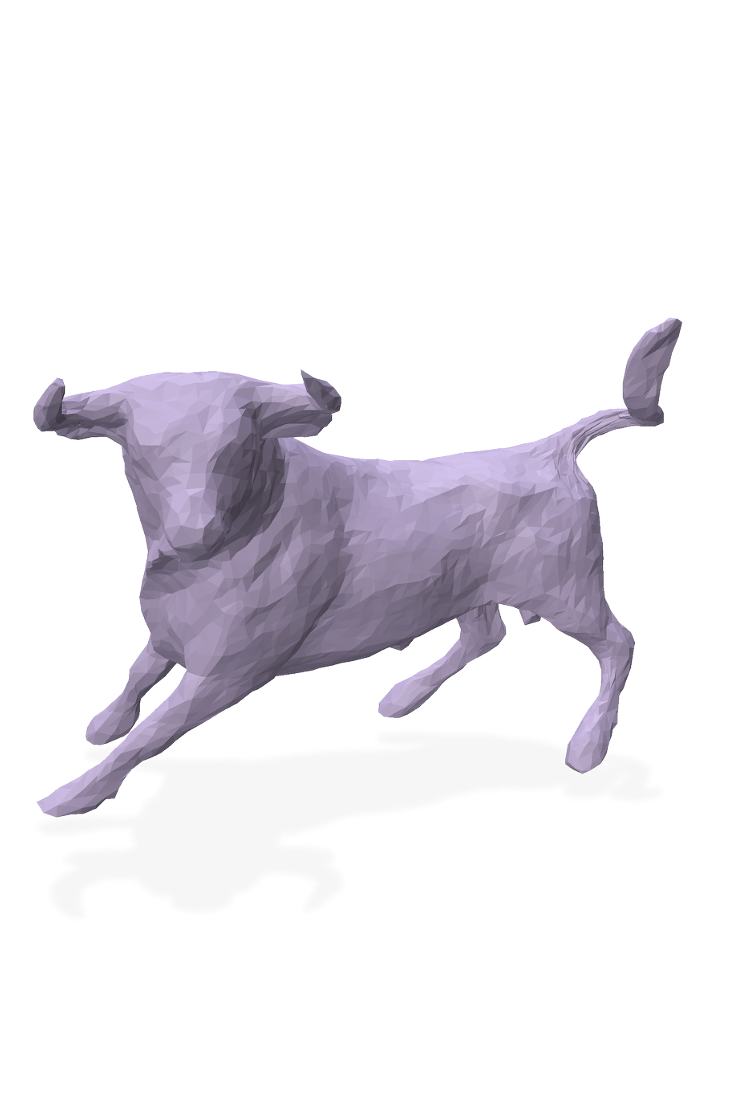
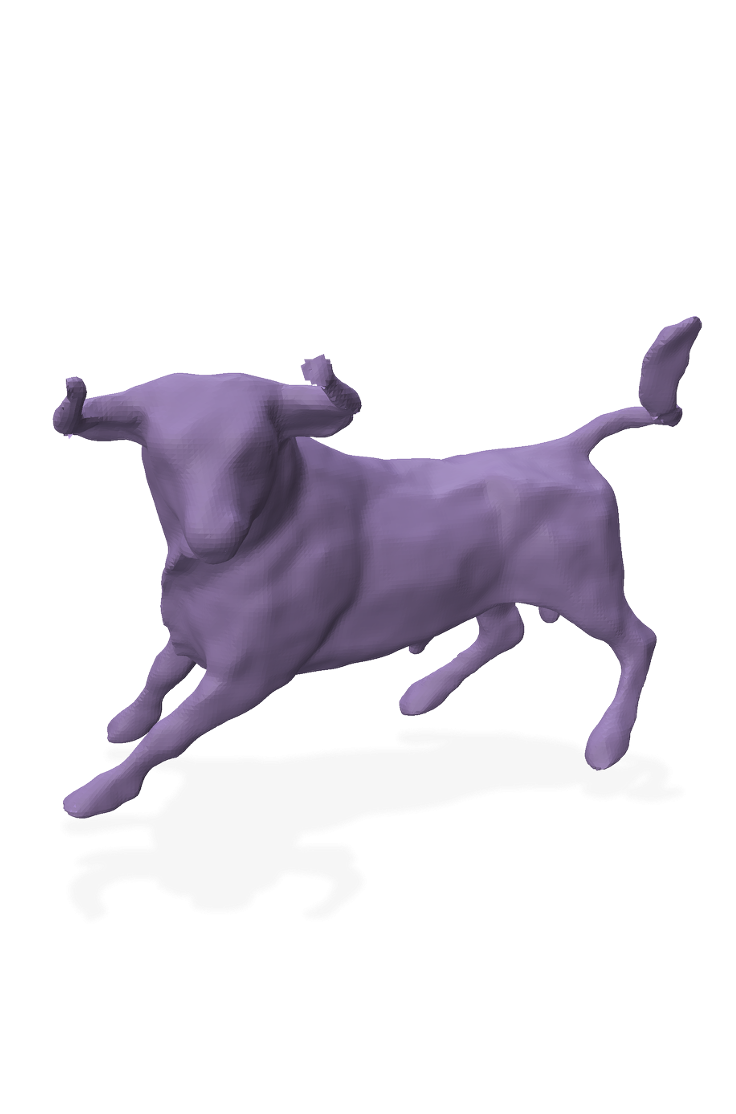
Point2Mesh vs. Ours
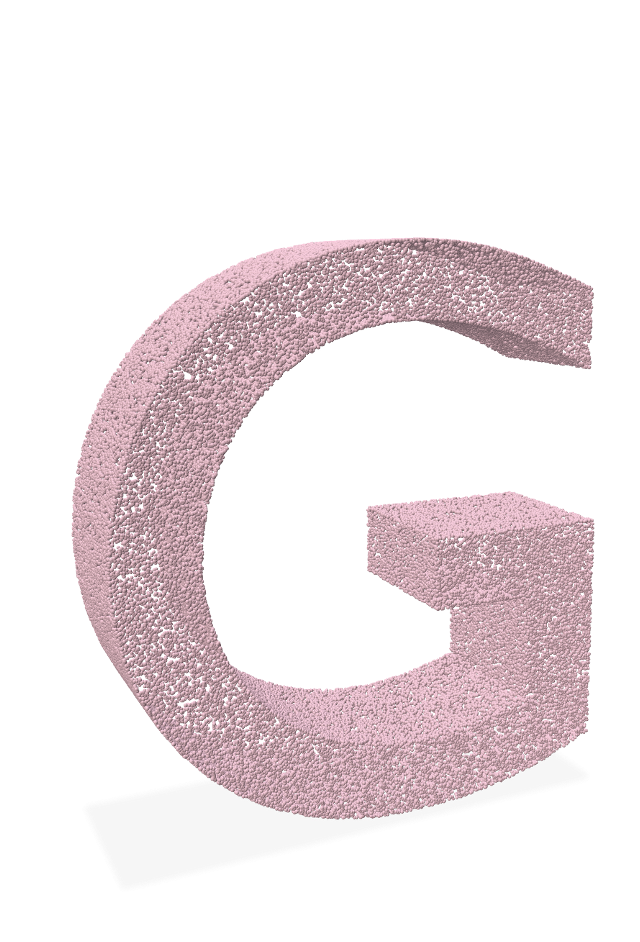
Drag to compare Point2Mesh (A) against our method (B) across six shapes. The input point cloud is shown above each slider.
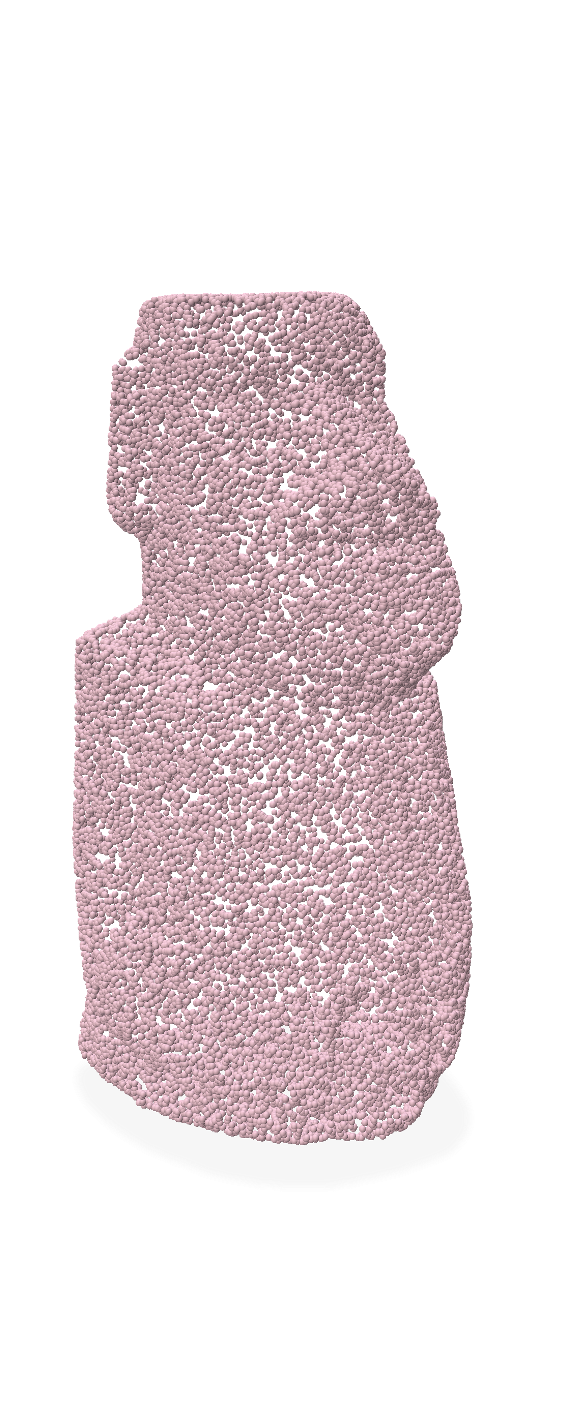
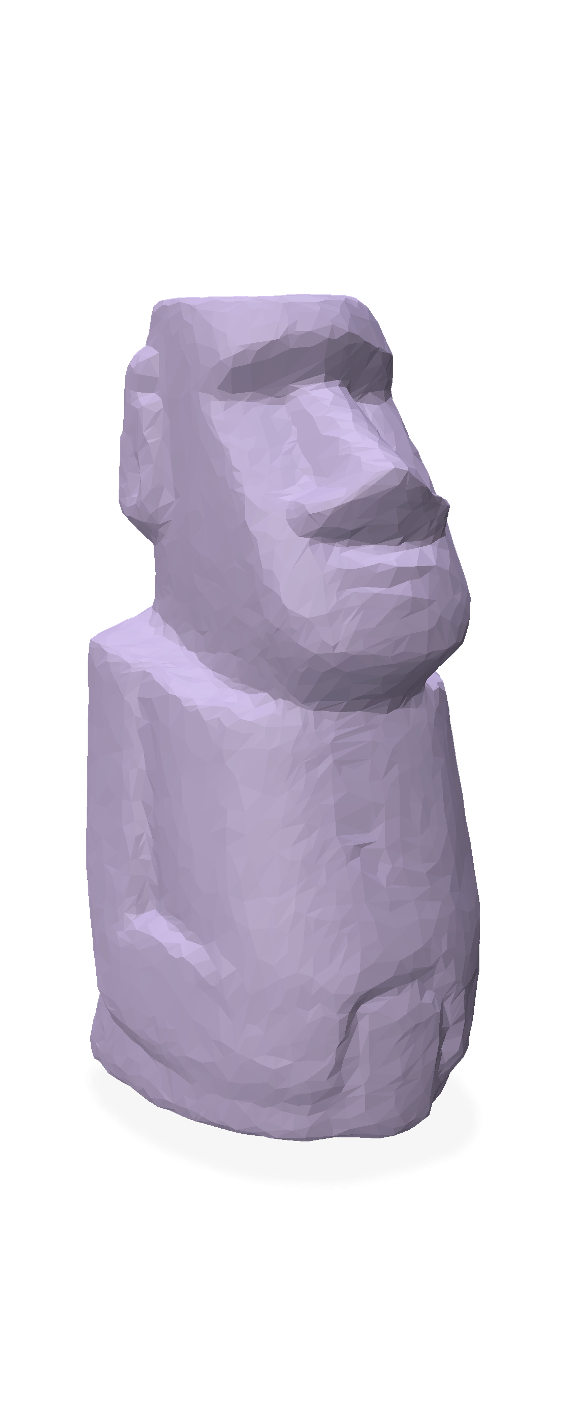
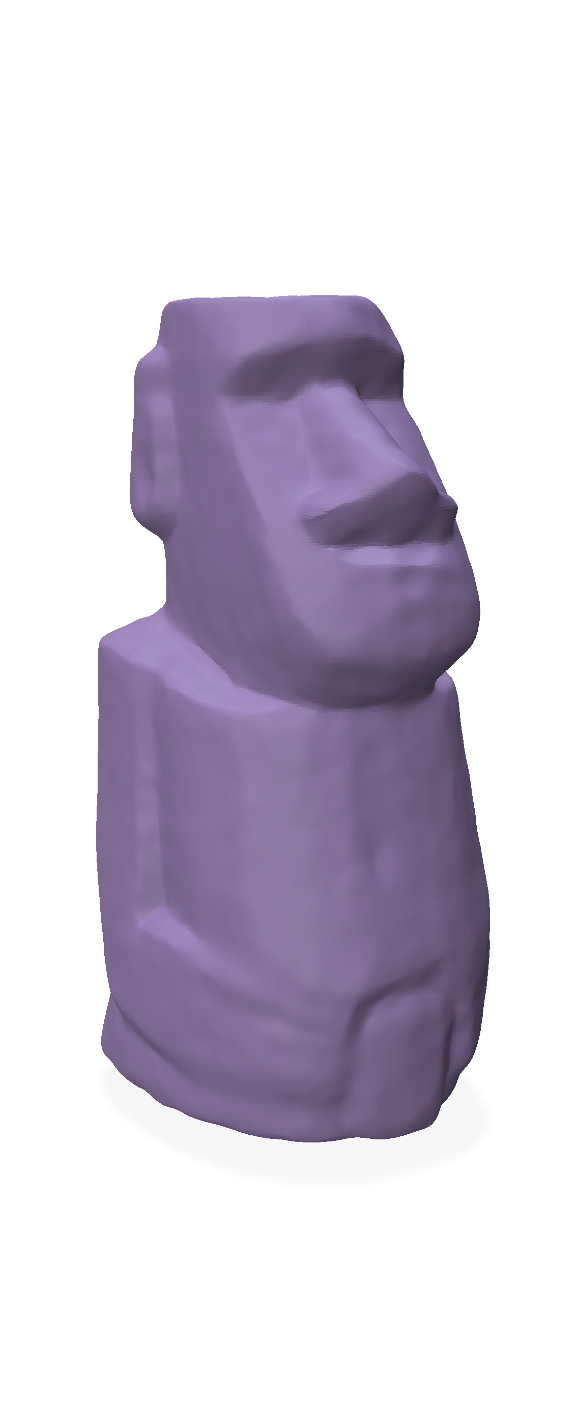
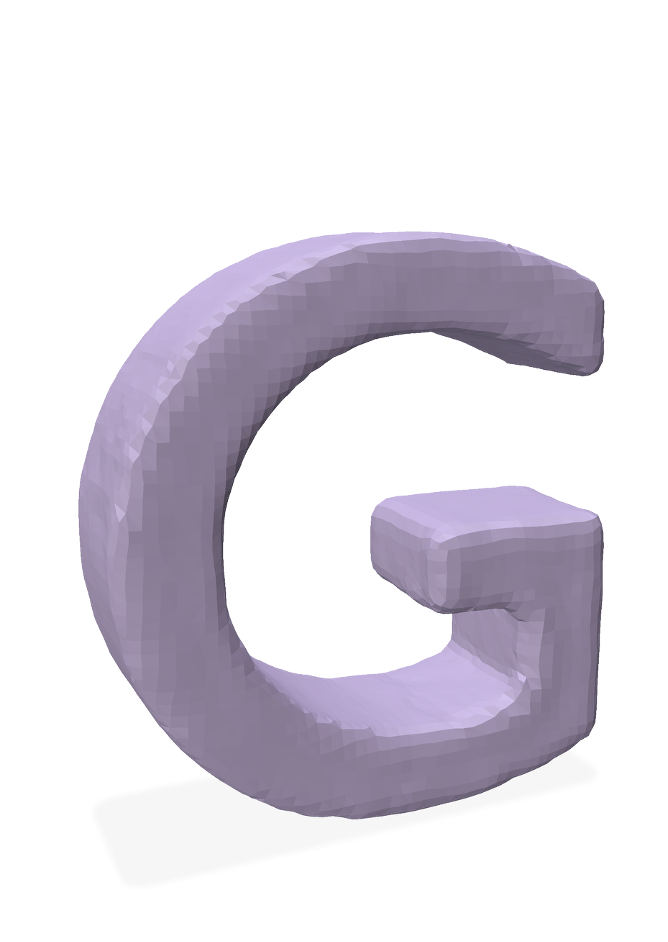
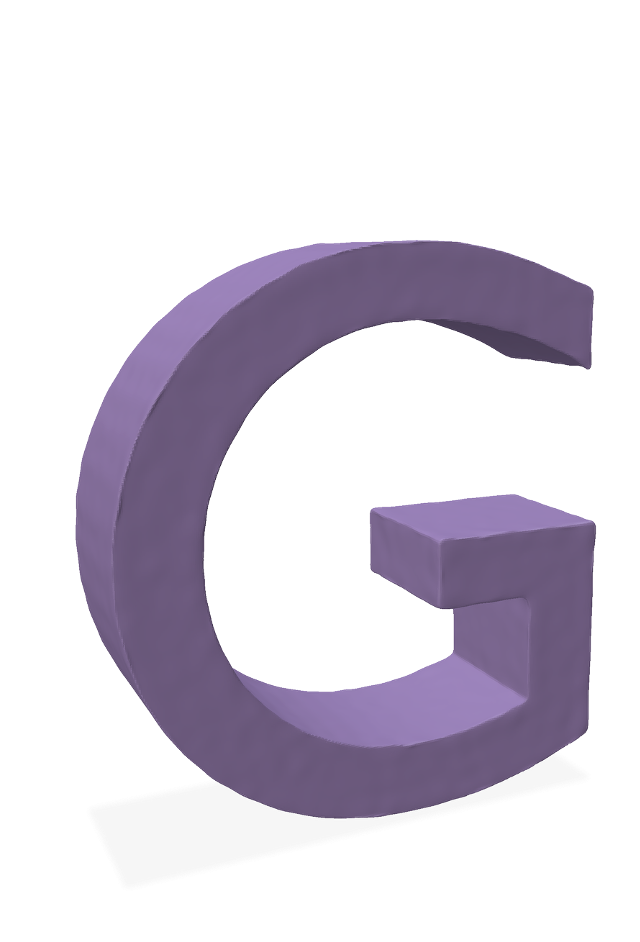
Further results
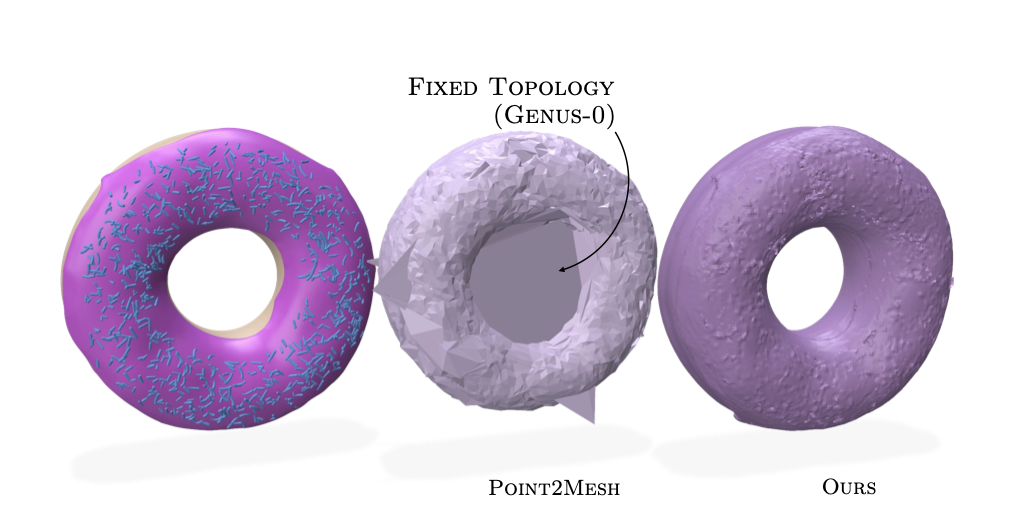
Topological flexibility. Deformation-based methods like Point2Mesh are locked to genus-0 surfaces. Our implicit field handles arbitrary topology without modification.
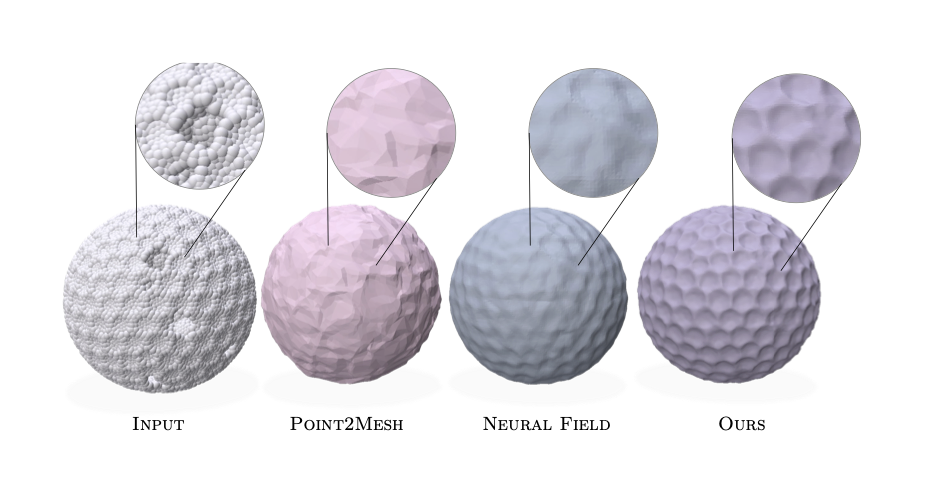
Attention prior ablation. Without cross-attention the field over-smooths the repetitive dimple pattern. With it, fine periodic geometry is recovered faithfully.
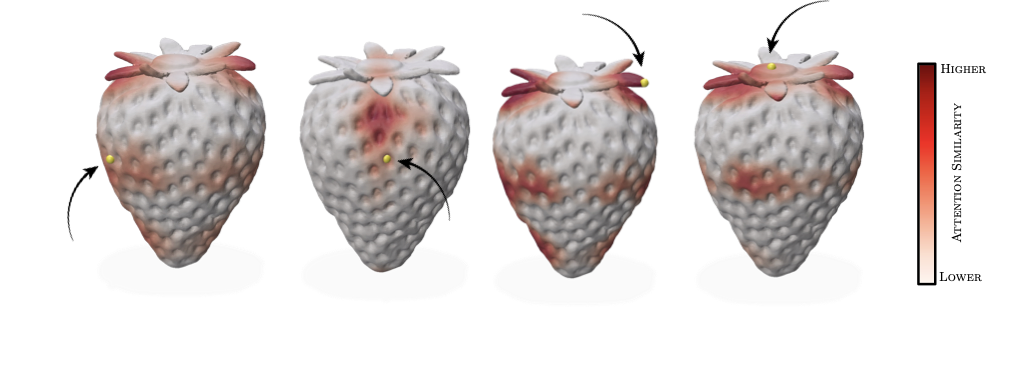
Learned self-prior. Attention similarity from a query point on a leaf — warm regions share high attention, coupling all leaf-like structures across the shape.
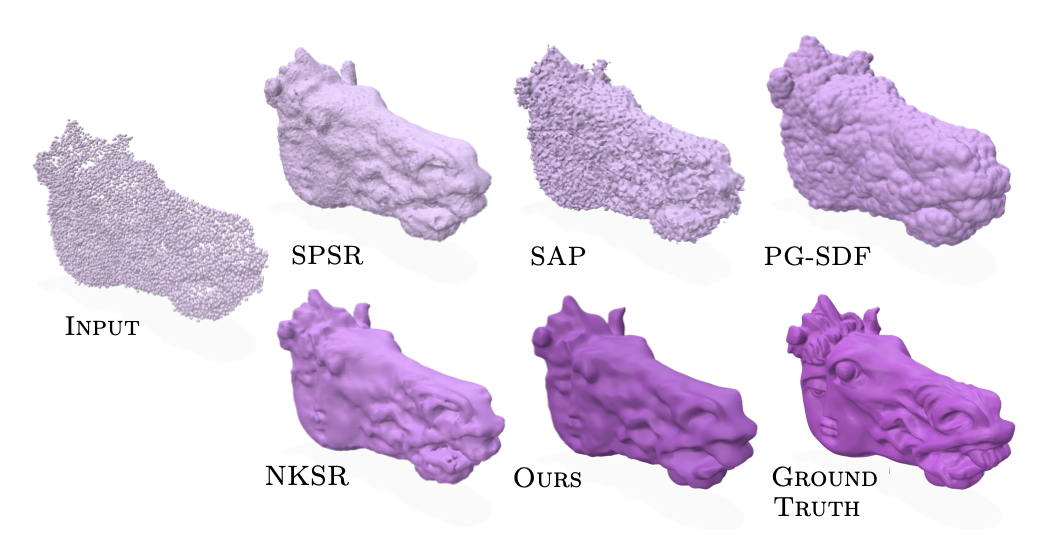
Noise robustness. On noisy Thingi10K scans, fine surface detail is preserved better than SPSR, SAP, and PG-SDF — without any noise-specific training.
Quantitative Comparison
Surface Reconstruction Benchmark
| Method | CD ↓ | HD ↓ | NC ↑ | FS ↑ |
|---|---|---|---|---|
| SPSR | 0.413 | 1.498 | 0.919 | 71.63 |
| DGP | 0.022 | 0.701 | 0.951 | 75.67 |
| Point2Mesh | 0.177 | 0.902 | 0.857 | 24.47 |
| PCP | 0.283 | 2.039 | 0.900 | 49.39 |
| NIMLS | 0.283 | 1.992 | 0.913 | 54.62 |
| NKSR | 0.019 | 0.614 | 0.949 | 75.98 |
| SAP | 0.024 | 0.682 | 0.936 | 75.50 |
| Ours | 0.016 | 0.484 | 0.956 | 75.54 |
Self-Similar Dataset
| Method | CD ↓ | HD ↓ | NC ↑ | FS ↑ |
|---|---|---|---|---|
| SPSR | 0.248 | 1.475 | 0.866 | 61.89 |
| SAP | 0.021 | 0.690 | 0.906 | 71.21 |
| NKSR | 0.019 | 0.512 | 0.897 | 68.56 |
| Point2Mesh | 0.239 | 1.384 | 0.695 | 19.24 |
| NSH | 0.043 | 0.971 | 0.859 | 61.95 |
| WDG | 0.038 | 1.246 | 0.785 | 48.39 |
| PG-SDF | 0.019 | 0.397 | 0.872 | 66.38 |
| Ours | 0.017 | 0.438 | 0.907 | 72.44 |
Ablation Study
| Attention | RIMLS | Params | CD ↓ | HD ↓ | NC ↑ | FS ↑ |
|---|---|---|---|---|---|---|
| ✗ | ✗ | 1.18M | 0.021 | 0.534 | 0.876 | 66.62 |
| ✓ | ✗ | 1.16M | 0.019 | 0.494 | 0.903 | 67.52 |
| ✓ | ✓ | 1.16M | 0.017 | 0.438 | 0.907 | 72.44 |
Attention and RIMLS contribute complementary improvements with no added parameter cost.
BibTeX
@inproceedings{fogarty2026attnprior,
  title={Self-Supervised Implicit Attention Priors for Point Cloud Reconstruction},
  author={Fogarty, Kyle and Cai, Chenyue and Yang, Jing and Guo, Zhilin and Oztireli, Cengiz},
  booktitle={International Conference on 3D Vision (3DV)},
  year={2026},
  url={https://arxiv.org/abs/2511.04864}
}